 Luis de la Barrera
Harmonic Musical Systems
Abstract
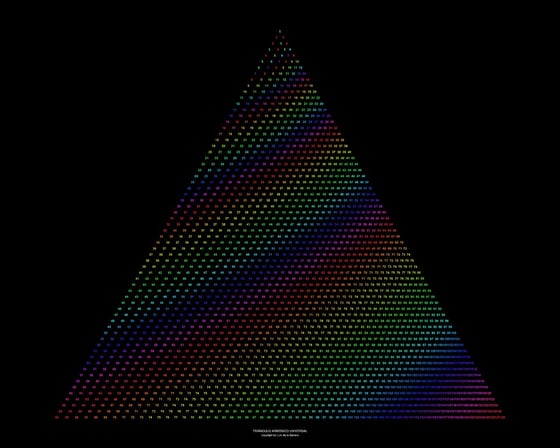
This work presents a unified theoretical framework for the formulation of harmonic musical systems grounded exclusively in the physical-harmonic phenomenon. Starting from the intrinsic properties of the harmonic series, it establishes a set of structural principles governing the emergence, organization, and limitation of musical intervals and scales. The study first revisits the Pythagorean system and systems of just intonation, not as isolated historical constructions, but as successive manifestations of a common generative mechanism articulated through harmonic lines and their interactions within a universal harmonic triangle.
Through a systematic analysis of intervallic deviations, geometric progressions, and transformation coefficients, the work demonstrates how so-called “second-generation” systems arise naturally from the controlled adjustment of earlier ones, without violating physical-harmonic constraints. Particular attention is given to the transformation coefficient linking the Pythagorean and just intonation systems, which is shown to play a decisive role in the structural continuity of harmonic organization.
The final part of the study reexamines the twelve-tone equal-tempered system, traditionally regarded as an artificial or purely pragmatic construction. By embedding its intervals within bounded geometric progressions derived from the same physical-harmonic principles, the work demonstrates that the tempered system is not an anomaly, but rather a latent and coherent outcome of the harmonic framework itself.
The apparent deviations of its intervals are shown to be perceptually and structurally compensated by affine relationships and harmonic substitutions inherent to the system.
As a result, the twelve-tone equal-tempered system is reinterpreted as a legitimate harmonic musical system, sustained by the same physical laws that govern earlier systems, albeit under exceptional conditions that neutralize hierarchical distinctions among harmonic lines. This reinterpretation provides a coherent theoretical foundation for understanding temperament not as a rupture, but as an extreme and integrative realization of harmonic musical order.

1.1 Definition of System.
1.2 The Physical-Harmonic Principle.
1.3 The Unison and the Octave: The Concept of Equilibrium.
1.4 The Rest of the Intervals. The Concept of Instability.
Chapter II. Determination of the Basic Harmonic Series. The Harmonic Triangle.
2.1 The Basic Harmonic Series.
2.2 Formation of the Harmonic Triangle.
2.3 The Harmonic Framework.
2.4 Graphic Rectification of the Harmonic Triangle.
2.5 Brief Analysis of the Universal Harmonic Lines.
Chapter III. The Synthesis of a Harmonic Musical System.
3.1 From the Universal Harmonic Triangle to the Particular Harmonic Triangle of a System.
3.2 Determination of the Sounds of a System.
3.3 Synthesis of a First Harmonic Musical System.
Chapter IV. Second-Generation Harmonic Musical Systems.
4.1 Harmonic Dispersion in the Pythagorean System.
4.2 The Formation of a New Harmonic Musical System.
4.3 The Synthesis of the Tonal System.
Chapter V. Unified Systems.